Role
Design Lead
Duration
06/2021 - 08/2021
Problem Statement
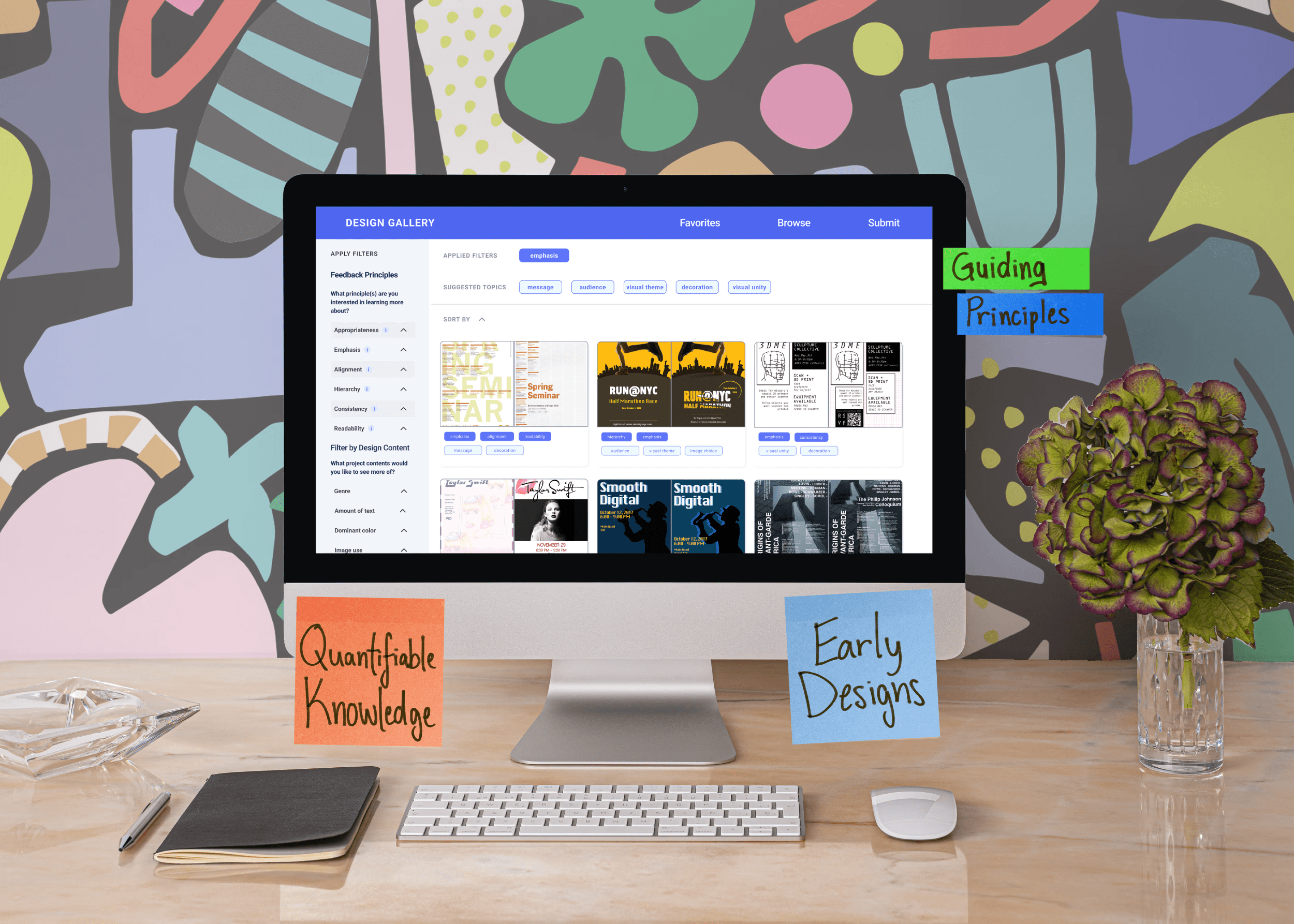
At the Design Lab at UCSD, I worked with Dr. Grace Yen and Professor Steven Dow to make learning design more accessible. We aimed to simulate a collaborative classroom environment for design novices and those without access to formal design education.
From existing literature, many novice designers struggle without mentor and community guidance and flounder from studying an abstract field in an unstructured way. Our goal was to help novices gain confidence and improve their design skills by creating an educational gallery.

Prototyping
How might learning from an educational gallery's experience differ from learning through a traditional gallery?
Because Dr. Yen had designs from previous research, I made wireframes, a medium-, and a high-fidelity prototype based on them. Particularly, I aimed to create a modular design so that it could be easily outfitted with learning widgets.
The prototype specifically examined how a gallery crafted in a vicarious learning style can offer greater scaffolding in the design learning process, compared to traditional design sites, such as Dribble and Behance.
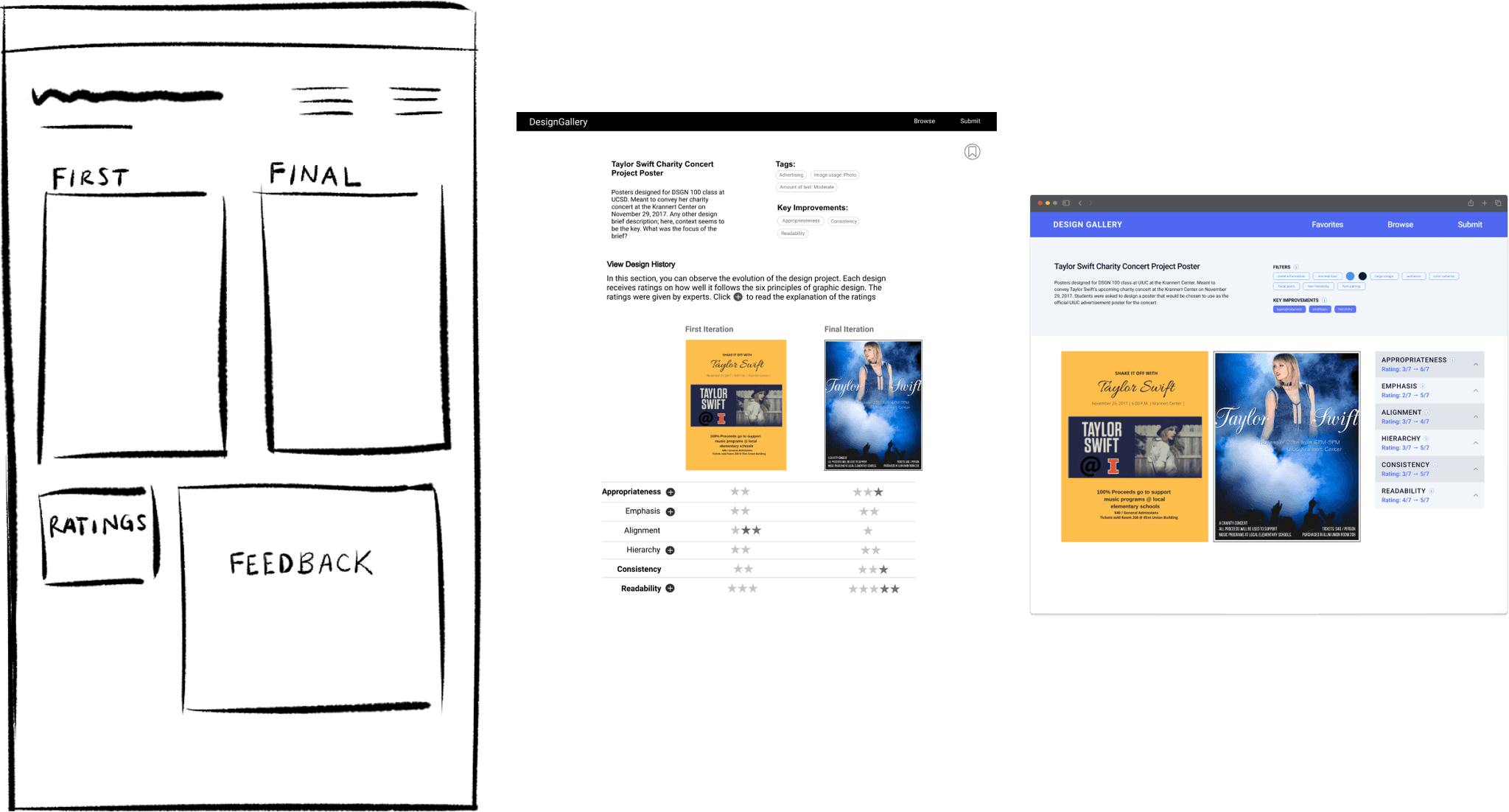
The prototype evolution for viewing the first and final iterations of a design.
The gallery itself had three main parts: browsing designs, viewing items, and reflecting on designs. I created widgets and pages for each, including a main gallery with filters and suggestions, a page for individual design processes with feedback, a favoriting feature, and reflection features. It was built with the following assumptions and ideas from Dr. Yen’s previous research in mind:
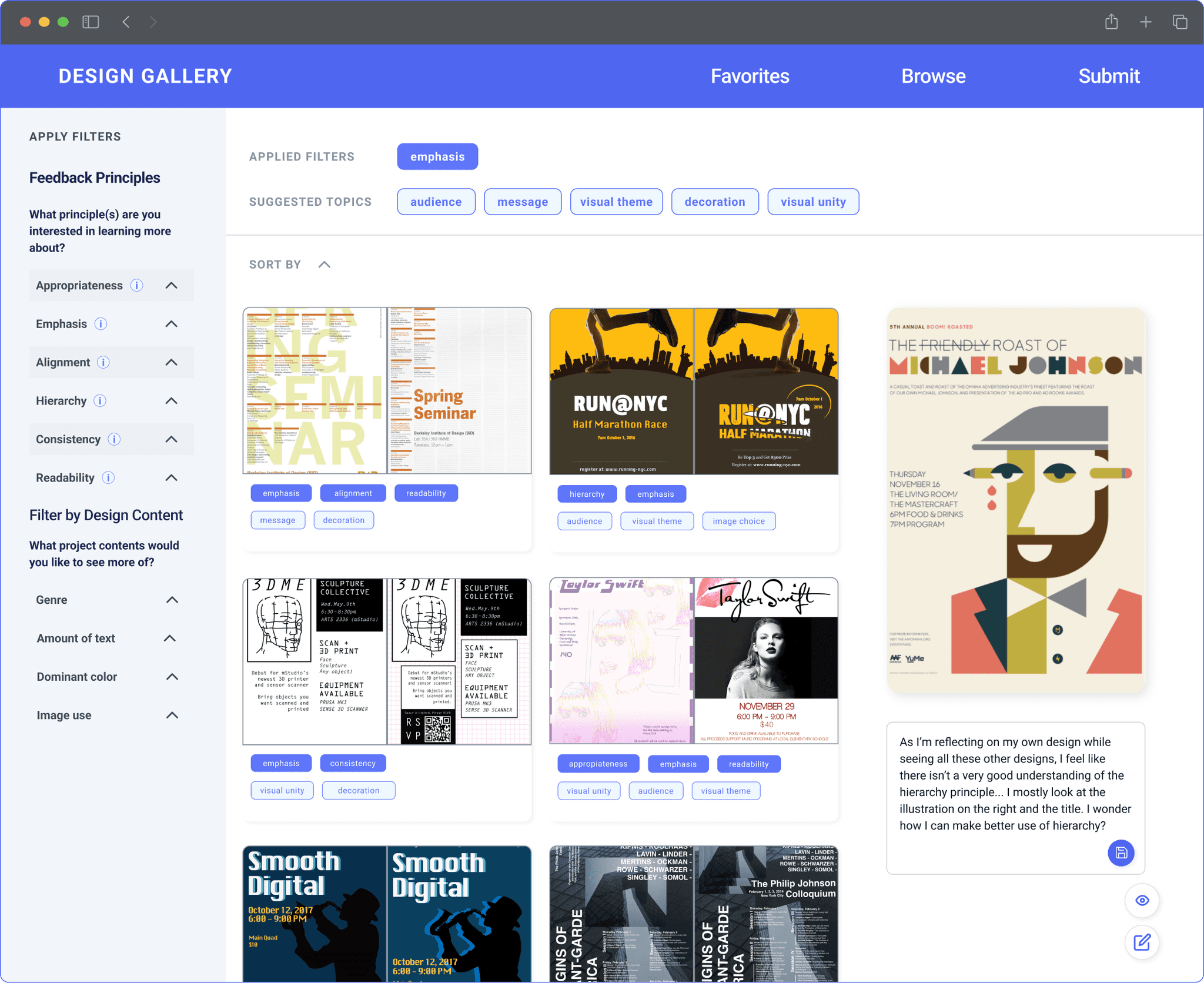
By breaking down abstract concepts into clear design principles, users can more quickly understand and internalize key ideas for their own designs.
Exploring relevant example designs at the right time through filtering helps novices generate ideas more thoroughly and effectively.
Allowing novices to see the first and last versions of a design with the feedback the designer received builds confidence and provides them with ideas on how to improve.
By submitting their own designs, novices can become part of a "classroom" where they can receive feedback from others and reflect on their own work.

Testing
I tested the prototype by leading 6 think-aloud usability tests and a lab-wide feedback session. While participants were familiar with design repositories, they were not used to an educational one, resulting in hesitation and uncertainty while using features.
As a result, we adjusted the prototype to frame it as an educational tool, not just a place to view designs. We introduced search suggestions to encourage exploration, primed participants to think of designs in terms of concrete design concepts, and encouraged active reflection through prompts and a note-taking widget.
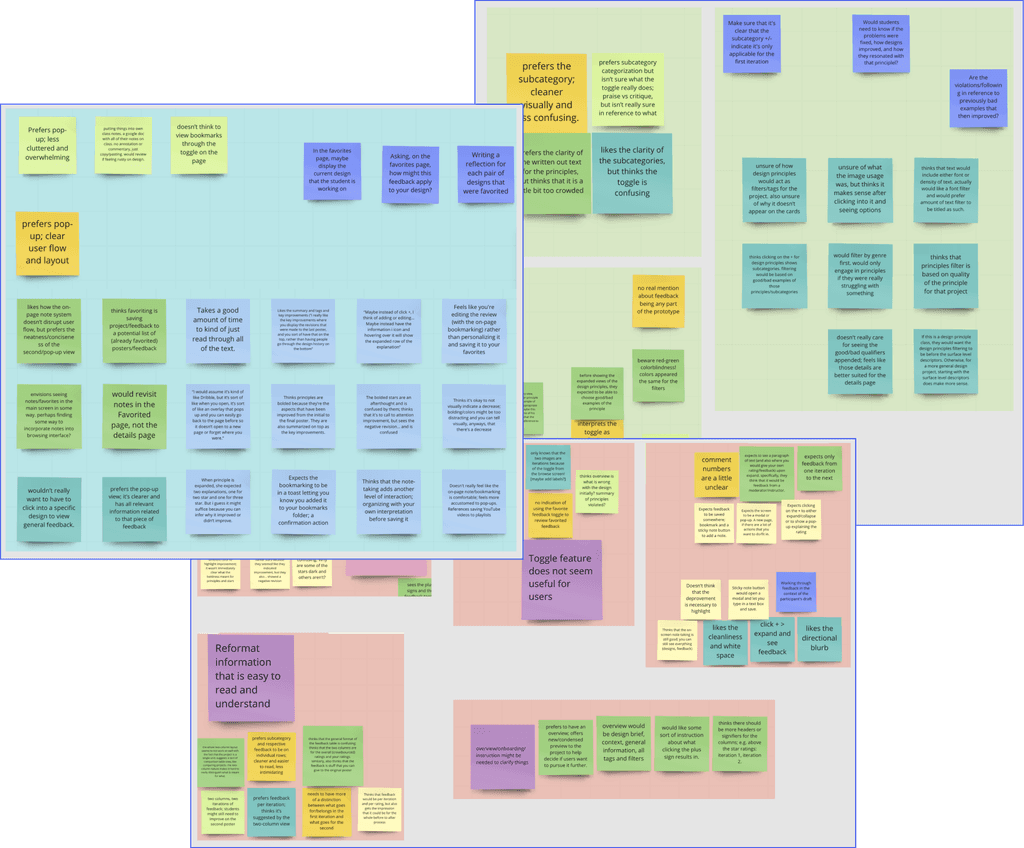
A preview of the affinity map created to synthesize insights from usability testing.
Other key insights from testing that shaped the prototype were:
Juxtaposing both designs was key for helping students understand how feedback shaped the iterative design process. We tested out smaller designs with expert feedback underneath and designs with expert feedback superimposed on the images. Ultimately, we opted for the final design (above) to balance design visibility with ease of expert feedback access.
A simple UI without too many icons or symbols should be prioritized so they don't add noise to the designs on display and clutter the student's learning space.
Using and navigating the gallery without any onboarding results in a very limited interaction and exploration of the widgets available.
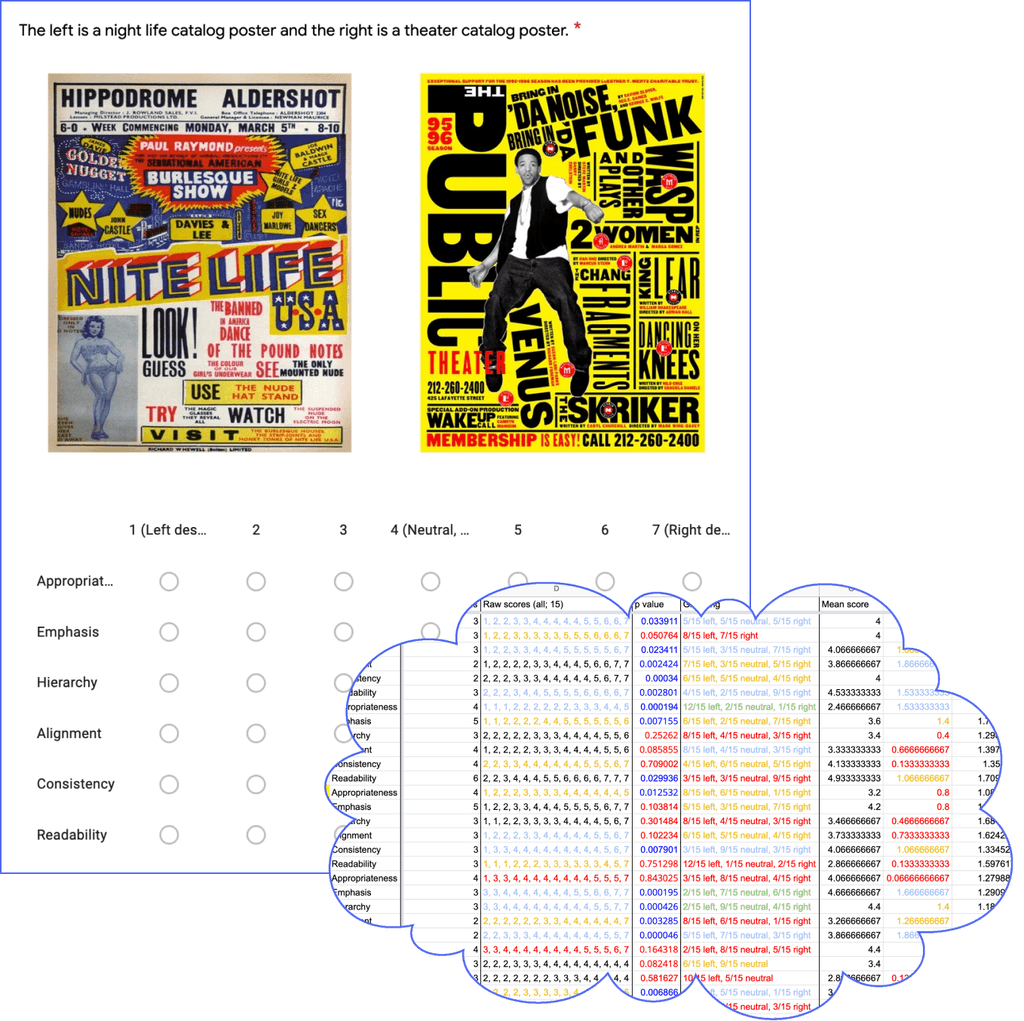
An example assessment question and the statistical analysis that goes along with it.
To analyze the potential efficacy of our gallery, I created an assessment to measure design knowledge and distinguish between design experts and beginners. The assessment evaluates the participant’s understanding of the design concepts focused on in the gallery.
The questions use a seven-point scale that allow us to do a numerical analysis through t-tests, standard deviation, range, and other statistics. We validated validated the assessment through 15 beginners and 5 experts.
While the research is still in-progress, preliminary pilot test results support the idea that there is a gap in how we approach design education and education in general and how we might be able to scaffold this gap.
As a tool, we believe that it can create real impact by making education more accessible for self-taught novices and by providing a framework for teaching abstract subjects.